Custom-Built Website vs Template: Which Is Right for Your Business in 2026?
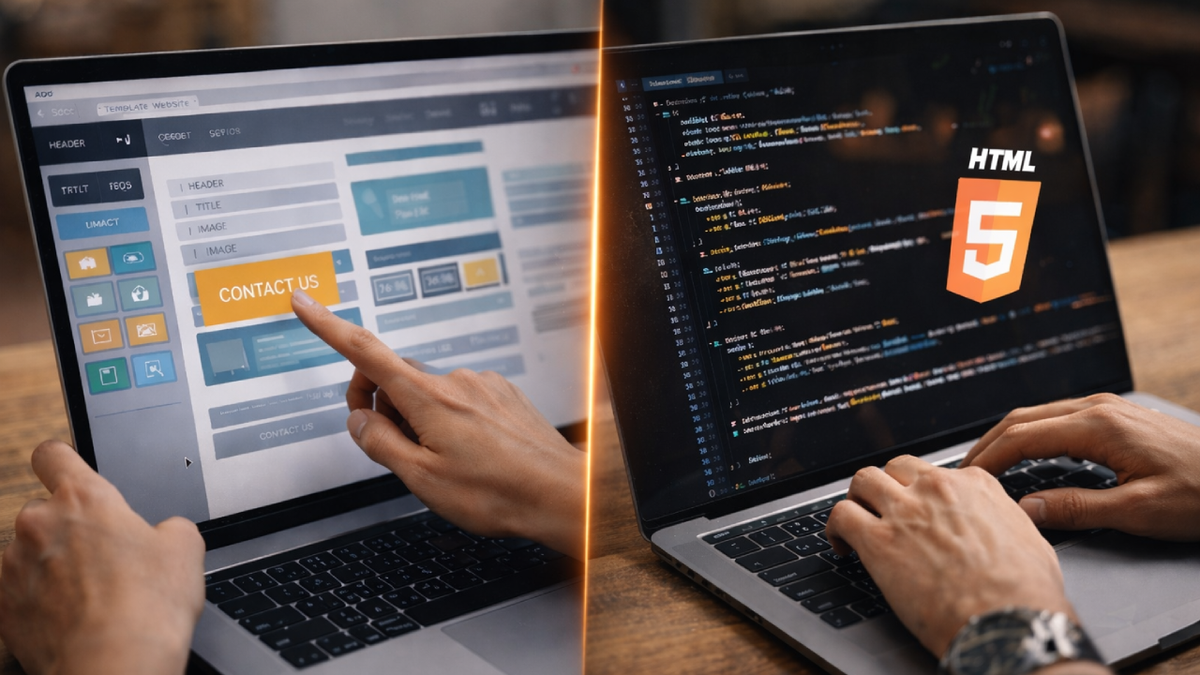
Template websites have never been easier to set up. Drag-and-drop builders, pre-made themes, and one-click installs mean anyone can have a website live in a weekend. But "easy to set up" and "good for your business" are not the same thing. In 2026, the gap between what a custom-coded website can do and what a template allows has never been wider — and the businesses choosing custom are pulling ahead.
This is not an argument against templates in every situation. For a personal blog or a temporary event page, a template may be perfectly adequate. But if your website is a business asset — something you expect to generate leads, build brand authority, rank on Google, and grow with your company — this guide will show you exactly why custom-coded development is worth the investment, and when it genuinely is not.
- What "custom-built" and "template" actually mean in 2026
- Head-to-head: 10 dimensions compared
- Performance: the dimension that affects everything else
- The technology behind a properly custom-coded website
- Why custom websites rank better on Google
- Who should choose custom, and who can use a template
- The real cost of each option over 3 years
- Frequently asked questions
1. What "Custom-Built" and "Template" Actually Mean in 2026
These terms get used loosely, so let us be precise about what each actually means before comparing them:
- Unique design created in Figma for your brand
- Coded by hand — HTML, CSS, JS, backend
- No pre-existing constraints on layout or features
- Built on frameworks like Django, React, Next.js
- Every pixel and function is intentional
- You own 100% of the source code
- Pre-designed theme purchased or downloaded
- Content inserted into existing structure
- Layout and features limited by what the theme allows
- Usually built on WordPress or a website builder
- Shared by potentially thousands of websites
- Theme code often not owned by you
There is also a middle ground that is worth naming: customised templates — where a developer takes a theme and modifies it significantly. This is better than a plain template but still carries most of the same limitations, since the underlying structure and code constraints remain.
2. Head-to-Head: 10 Dimensions Compared
| Dimension | Custom-Built | Template | Winner |
|---|---|---|---|
| Page speed | Only what is needed — no bloat | Loads all theme assets even when unused | Custom |
| Design uniqueness | One of a kind — built for your brand | Shared by thousands of other websites | Custom |
| SEO control | Full control over every technical signal | Limited by theme and plugin structure | Custom |
| Security | No public attack surface from known plugins | WordPress + plugins = frequent vulnerabilities | Custom |
| Scalability | Architected to grow with your business | Breaks or slows under heavy traffic | Custom |
| Feature flexibility | Any feature can be built | Limited to what plugins support | Custom |
| Launch speed | 4–12 weeks for full build | Days to 2 weeks | Template |
| Upfront cost | Higher investment | Lower initial cost | Template |
| Brand differentiation | Stands out completely | Looks like competitors using the same theme | Custom |
| Long-term ROI | Grows in value — lower rebuild cost later | Often rebuilt within 18–24 months | Custom |
Templates win on speed to launch and initial cost — and those are legitimate advantages for the right context. But on every dimension that determines how a website performs as a business asset over time, custom-built wins decisively.
3. Performance: The Dimension That Affects Everything Else
Page speed is no longer just a technical metric. Google uses Core Web Vitals — a set of performance measurements — as a direct ranking factor. A slow website ranks lower, converts worse, and costs more to advertise on Google Ads (lower Quality Score). The performance gap between custom and template sites is large and measurable:
Here is how typical PageSpeed Insights scores compare across site types:
Mobile PageSpeed scores — approximate averages. Actual scores vary by implementation and optimisation effort.
The reason for this gap is architectural. A template website loads the entire theme's CSS, JavaScript, and plugin code — whether your page uses those features or not. A custom-built site loads only what each specific page needs. The result is a dramatically lighter, faster experience for every visitor.
4. The Technology Behind a Properly Custom-Coded Website in 2026
When we talk about custom web development, we are talking about a specific set of modern technologies chosen for their performance, maintainability, and capability. Here is the stack used for custom-built websites at Softverses — and why each choice matters:
Frontend
React and Next.js are the gold standard for modern frontend development. Next.js adds server-side rendering (SSR) and static site generation (SSG) on top of React — meaning pages are pre-rendered on the server and delivered instantly, rather than being assembled in the browser. This is one of the primary reasons Next.js sites score so well on Core Web Vitals. For simpler sites that do not need interactivity, clean semantic HTML and CSS — written by hand rather than generated by a page builder — produces the leanest, fastest possible output.
Backend
Django is a mature, battle-tested Python framework used by Instagram, Pinterest, and Disqus at massive scale. It includes built-in protection against SQL injection, CSRF, XSS, and clickjacking — the most common web security vulnerabilities that plague poorly maintained WordPress sites. Wagtail, built on Django, gives content editors a powerful and intuitive CMS without the security baggage of WordPress and its plugin ecosystem. Our web development service is built entirely on this stack — chosen for reliability, security, and longevity.
Database
PostgreSQL is the preferred database for complex custom applications — it supports advanced data types, full-text search, and handles concurrent writes far better than the MySQL databases used by most shared WordPress hosting. Redis is used for caching frequently accessed data, meaning repeated visits to the same page do not hit the database at all.
Infrastructure
Deploying on Google Cloud with Nginx as the web server gives custom sites granular control over caching, compression, and request routing that shared WordPress hosting simply cannot match. A Cloudflare CDN layer in front of the site delivers static assets from servers geographically close to each visitor — meaning a buyer in Chennai and a buyer in Dubai both experience fast load times regardless of where the server is physically located.
"A template gives you a website that works. Custom development gives you a website that performs. In a market where page speed affects your Google ranking and slow sites cost you conversions, that difference is measured in revenue."
5. Why Custom Websites Rank Better on Google
Search engine optimisation is not just about keywords and backlinks. The technical architecture of your website directly determines how well it can rank. Here is where custom-built sites have a structural advantage:
| SEO Factor | Custom-Built | Template (WordPress + plugins) |
|---|---|---|
| Core Web Vitals (LCP, CLS, INP) | ✓ Engineered to pass | ✗ Often fails — bloated assets |
| URL structure | ✓ Clean, full control | ⚠ Depends on permalink settings |
| Schema / structured data | ✓ Precisely implemented in code | ⚠ Plugin-generated, often bloated |
| Duplicate content risk | ✓ Zero if architected correctly | ✗ Category / tag / date archives |
| Crawl budget efficiency | ✓ No junk URLs for Googlebot | ✗ WordPress generates many indexable admin URLs |
| Image optimisation | ✓ WebP, lazy load, correct dimensions | ⚠ Requires separate plugin to manage |
| Canonical tag control | ✓ Per-page, per-template precision | ⚠ Plugin handles it — sometimes incorrectly |
| Server response time (TTFB) | ✓ Sub-200ms typical | ✗ 400–900ms on shared hosting |
The cumulative effect of these technical advantages is significant. Businesses that migrate from a slow, plugin-heavy WordPress site to a custom-built solution consistently report meaningful improvements in organic search traffic — typically 25–60% within the first six months after migration, once Google has recrawled and re-evaluated the site. Our SEO service is structured to capture this uplift systematically after every custom build we complete.
6. Who Should Choose Custom — and Who Can Use a Template
Honesty matters here. Custom development is not right for every situation. Here is a clear framework:
Choose a custom-built website if:
- Your website is your primary channel for generating leads or sales
- You need features that no plugin or template supports out of the box
- Brand differentiation is important — you cannot afford to look like your competitors
- You are building an e-commerce store with a large catalogue or complex pricing
- You expect significant traffic growth over the next 2–3 years
- Security is critical — financial, medical, or sensitive data is involved
- You want to rank well on Google for competitive search terms
- You need a web application with user accounts, dashboards, or workflows
A template may be sufficient if:
- You are a solo professional needing a simple portfolio or personal site
- Your website is for a one-time event with a short lifespan
- You are testing a business idea and need to validate before investing
- Budget is genuinely constrained and a basic online presence is better than none
7. The Real Cost of Each Option Over 3 Years
Most cost comparisons focus on the upfront build cost. That is the wrong comparison. Here is what each option actually costs over a three-year period for a typical business website:
| Cost Component | Template (WordPress) | Custom-Built (Django / React) |
|---|---|---|
| Initial build cost | ₹20,000 – ₹60,000 | ₹80,000 – ₹3,00,000 |
| Premium theme / plugins (annual) | ₹8,000 – ₹25,000/year | Not applicable |
| Hosting (3 years) | ₹15,000 – ₹45,000 | ₹24,000 – ₹90,000 |
| Security patching / plugin updates | ₹5,000 – ₹15,000/year | ₹3,000 – ₹8,000/year |
| Performance fixes (speed / CWV) | ₹10,000 – ₹40,000 (typically needed) | Rarely needed — built in |
| Partial rebuild or major redesign | ₹40,000 – ₹1,20,000 (very common at 18–24 months) | Unlikely within 3 years |
| Lost revenue from downtime / hacks | Variable — WP sites hacked 3× more often | Minimal — hardened by design |
| Typical 3-year total | ₹1,30,000 – ₹3,50,000 | ₹1,40,000 – ₹4,50,000 |
The three-year totals are closer than most people expect — because template websites accumulate plugin costs, performance fix costs, and rebuild costs that are easy to ignore when looking only at the initial quote. Meanwhile, a custom-built site depreciates much more slowly and typically does not need a major rebuild within the same timeframe.
Add in the revenue impact — better Google rankings, faster load times, higher conversion rates — and the custom-built option consistently delivers stronger ROI for businesses with genuine digital growth ambitions. You can see real examples of custom-built websites we have delivered for Kerala and Indian businesses in our project portfolio.
Thinking about a custom-built website?
Every website we build at Softverses is designed from scratch in Figma and coded by hand — no templates, no page builders. Based in Thrissur, Kerala, with 70+ completed projects.
Talk to Our Team →8. Frequently Asked Questions
Final Thoughts
The template vs custom debate is not really about templates being bad. It is about fit for purpose. Templates are tools — useful in the right context, limiting in others. When your website is a core business asset that is expected to generate revenue, rank on Google, and represent your brand in a competitive market, the constraints of a template become real costs: slower pages, shared design identity, SEO compromises, and an architecture that fights you as you try to grow.
Custom-coded development — designed from scratch in Figma and built with modern frameworks like Django, React, and Next.js — removes those constraints entirely. The investment is higher upfront. The long-term returns are substantially better.
Every website we build at Softverses starts with a blank canvas and ends with something your competitors cannot replicate. Explore our portfolio of custom-built projects, read about our web development process, or start a conversation about your project — we are based in Thrissur and happy to give you an honest assessment of what your business actually needs.
Let's build something custom for your business
No templates. No page builders. Just clean, fast, custom-coded websites designed specifically for your brand and goals.
Start Your Project →